
More Alive Than You've Felt All Year: What the Knicks Crowd Reveals about High-Functioning Anxiety in New York
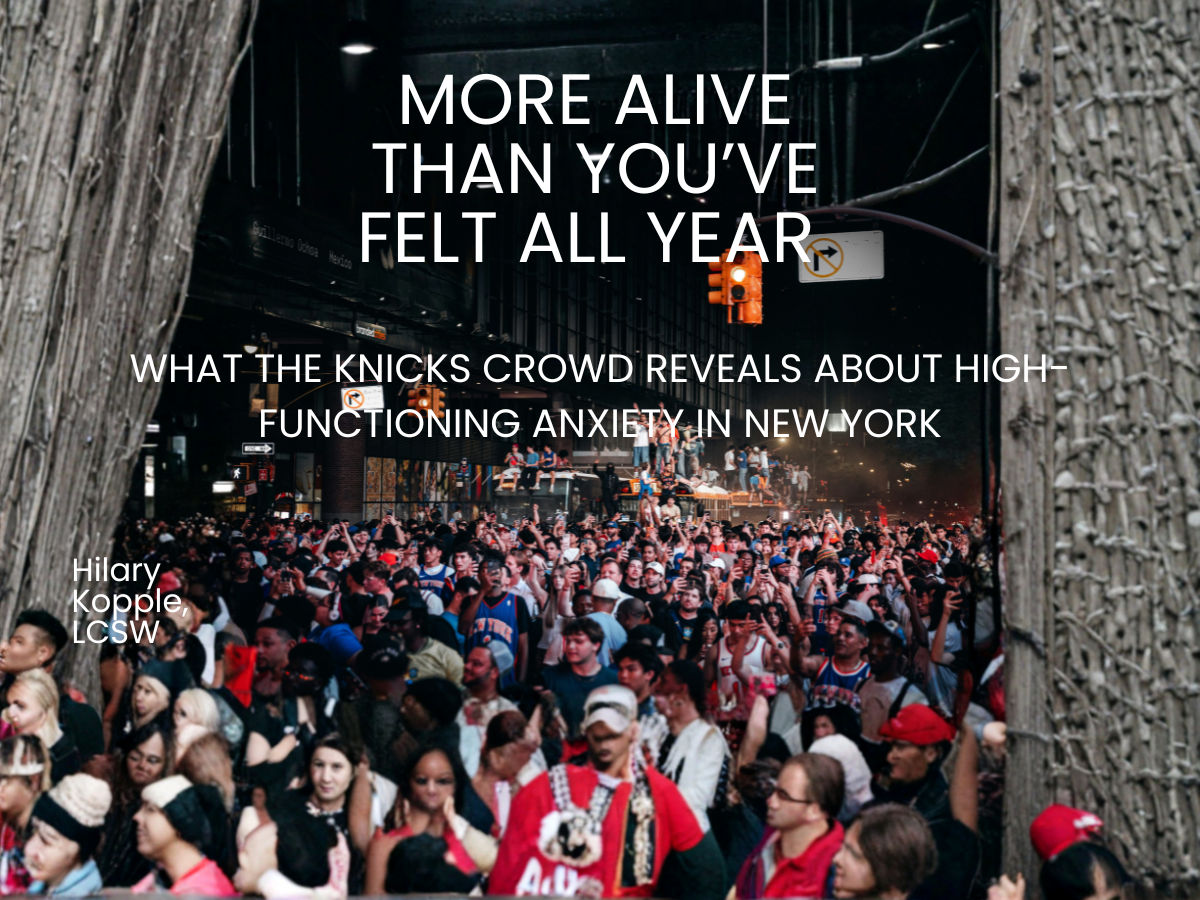
You probably saw the footage. The Garden emptying into the street, strangers hugging, a wall of sound that did not feel like noise so much as a current running through everyone at once. And if you were there, or even just watching it from your couch, there is a good chance you felt it too. Something rare. Something that does not come around often.
There is a name for that feeling. Sociologists call it collective effervescence, a term coined over a century ago to describe what happens in the body when a group shares an intense emotional moment together. Heart rhythms begin to synchronize. The nervous system shifts out of its everyday holding pattern. For a few minutes, you are not managing anything. You are simply feeling, without effort, alongside everyone else feeling it too.
That is worth sitting with for a second, because of what it reveals.
The feeling itself was not rare. The conditions for it were.
If you are a high-functioning professional in New York, there is a good chance that moment stood out so much precisely because it does not happen often. Most days, the calendar is full and accounted for. The emails get answered, the deadlines get hit, the household runs. From the outside, nothing looks wrong, because nothing is wrong in the way other people would notice.
But underneath that competence, a lot of days pass without anything registering quite that fully. Good news lands, but a little flat. Wins happen, but the feeling fades fast. You are not in crisis. You are also not always all the way here.
That gap between what you are capable of feeling and what you actually feel on an ordinary Tuesday is the thing worth talking about, especially for anyone who has spent years managing high-functioning anxiety in New York without quite naming it that way.
Why a crowd of strangers could access something therapy is built for
What made that crowd come alive was not the win itself. It was safety, intensity, and connection arriving at the same moment, giving the nervous system full permission to drop its guard all at once. That combination is rare to stumble into by accident. It is also exactly what nervous system informed therapy is designed to rebuild access to, deliberately and on a much smaller scale, in an ordinary week.
You do not need a championship run to feel something real. You need a nervous system that has not spent years being trained to keep itself composed first and feel things second.
For a lot of high achievers, that training started early. Achievement as the price of belonging, never enough as a baseline, competence as the safest thing to lead with. If that sounds familiar, it is worth understanding how anxiety shows up when you are good at hiding it. The strategy worked. It got you here. It also means the full, easy, effortless version of feeling something might only show up once a year, in a crowd of forty thousand strangers, instead of on a random night on your couch.
You do not have to wait for the next one
That feeling does not have to be locked behind a championship, a wedding, or some other once a year event. It is available more often than you think, once there is a little more room in your nervous system for it. A real conversation. A meal you actually taste. A morning where your chest is not already tight before you have opened your laptop.
Therapy, particularly approaches that work with the nervous system directly rather than only the thinking mind, can help build more of that room. Not by manufacturing intensity, but by making it safer to feel things on an ordinary day, not just an extraordinary one.
If you felt that aliveness this week and found yourself wishing it showed up more often, that wish is worth paying attention to.
If this is landing for you and you are ready to talk to someone, I would be glad to hear from you. You can reach out here to schedule a free consultation.
Author Bio

Hilary Kopple, LCSW, is a therapist in New York City specializing in anxiety and trauma therapy for adults who have built good lives and still feel like something is missing. She works with people who overthink, overfunction, and are tired of their own patterns, whether or not they can explain them. She integrates IFS, CBT, and somatic therapy as a combined approach that works on thoughts, the body, and the deeper patterns underneath both. To learn more, visit her Home page or read about her background on her About page. Reach out to schedule a free consultation.